Editor's note: The story is being updated.
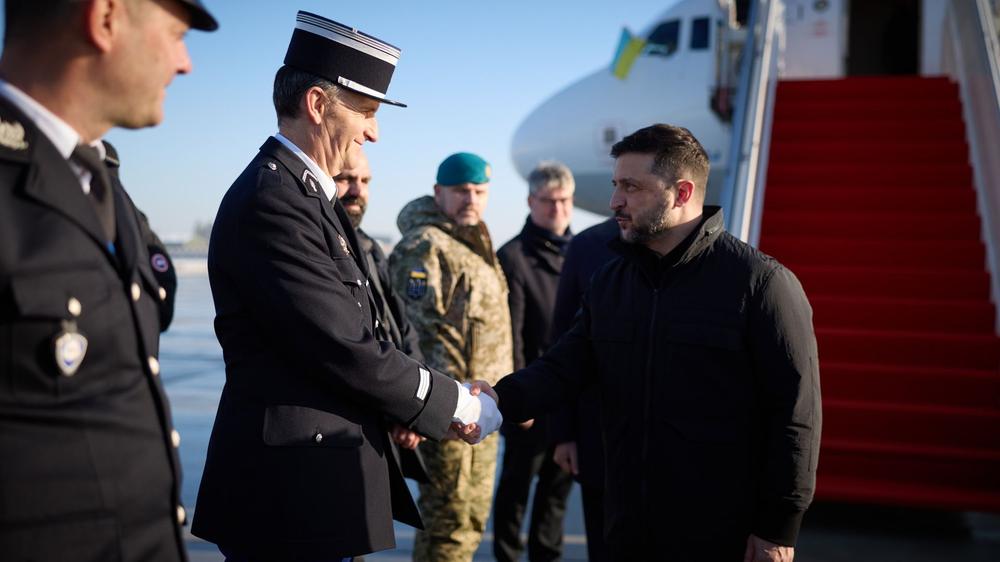
President Volodymyr Zelensky arrived in Paris on Jan. 6 to join discussions with European leaders and U.S. envoys on security guarantees for Ukraine, as Washington renews its push to broker a peace deal.
The "Coalition of the Willing" summit, hosted by French President Emmanuel Macron, takes place as Kyiv signals that a deal to end Russia's nearly four-year full-scale invasion is "90% ready."
U.S. Special Envoy Steve Witkoff and U.S. President Donald Trump's adviser Jared Kushner are joining the event, which will bring together leaders from 27 countries and NATO Secretary General Mark Rutte.
Ukraine's president is also accompanied by Kyrylo Budanov, a former military intelligence chief recently appointed as the presidential chief of staff, and National Security and Defense Council Secretary Rustem Umerov.
"These talks are meant to deliver more protection and strength for Ukraine," Zelensky said on X. "We are counting on our partners' support and on steps that can guarantee real security for our people."
Zelensky and Macron will hold a bilateral meeting at 12:15 p.m. local time, before their talks with Witkoff and Kushner, Zelensky's spokesperson Serhii Nykyforov told journalists. The Coalition of the Willing will begin its meeting in a closed-door format at 3 p.m., he added.
The session will be followed by a joint press conference with Zelensky, Macron, British Prime Minister Keir Starmer, and German Chancellor Friedrich Merz at 6:15 p.m. A separate meeting is scheduled to take place later in the evening between Zelensky, Kushner, Witkoff, and other U.S. and Ukrainian delegates, according to Nykyforov.
Earlier in the day, the military chiefs of Ukraine, the U.K., and France held discussions in Paris on implementing "modalities" of security guarantees for Kyiv ahead of the leaders' summit.
Alexus Grynkewich, the chief of the U.S. European Command and Supreme Allied Commander Europe, was also present at the talks, with military heads from other coalition countries joining online.
"The ongoing military work, carried out for months with our Coalition and in coordination with the United States, supports the political efforts to establish lasting peace on our continent," said French Chief of the Defense Staff Fabien Mandon after meeting his Ukrainian and U.K. counterparts, Andrii Hnatov and Rich Knighton, respectively.
A draft statement by the Coalition — yet to be approved by the leaders on Jan. 6 — includes "binding commitments" by members to support Ukraine in the event of a future Russian attack, Reuters reported.
These commitments include "military capabilities, intelligence and logistical support, diplomatic initiatives, adoption of additional sanctions," according to the draft reviewed by Reuters.
Trump's latest peace push led to a flurry of negotiations that saw the initial controversial 28-point peace plan reworked into a 20-point framework, with some key issues, such as the fate of partially occupied Donbas region, still to be decided.
Security guarantees are another crucial aspect of the discussed agreement. Zelensky said that bilateral guarantees between Ukraine and the U.S. are already "fully agreed," while a wider U.S.–Europe–Ukraine arrangement is nearing completion.
According to the president, the final agreement must include the physical presence of foreign troops — namely those from France and the U.K. — on Ukrainian territory.
Paris and London are spearheading the plan to deploy the so-called "reassurance force" in Ukraine after a peace deal is reached, aiming to help secure the country's infrastructure in the rear and rebuild its military.
Bloomberg reported that European leaders at the Paris talks aim to include the option of deploying U.S. troops to post-war Ukraine in the agreement, despite Washington having previously ruled out such proposals.
The talks with European leaders follow Zelensky's meeting with Trump at his residence in Mar-a-Lago, Florida. During a joint press conference with Zelensky on Dec. 28, Trump said the peace talks were in their "final stages," without providing further details.
After his conversation with Trump, Zelensky held a joint call with European leaders and met national security advisors of the Coalition of the Willing members in Kyiv on Jan. 3. Trump, in turn, spoke with Russian President Vladimir Putin on Dec. 29.
Russia has consistently opposed the presence of Western troops in Ukraine as part of a post-war agreement and continues to demand that Ukraine abandon NATO aspirations and cede the entire Donbas region, including territories still held by Kyiv's forces.
 Sony and Honda reveal new car that’s basically a PlayStation